
July Portfolio Update

What a month this has been! Ecobank became a 3-bagger, and Critical Holdings became a 2-bagger. I recycled some of the proceeds into African banks I like better from here.
[Addition: Had I bought Critical Holdings when I first wrote about it in the Malaysian Stocks post, I would now be up 319% - a 4-bagger. Alas, I waited another month and paid a much higher price.]

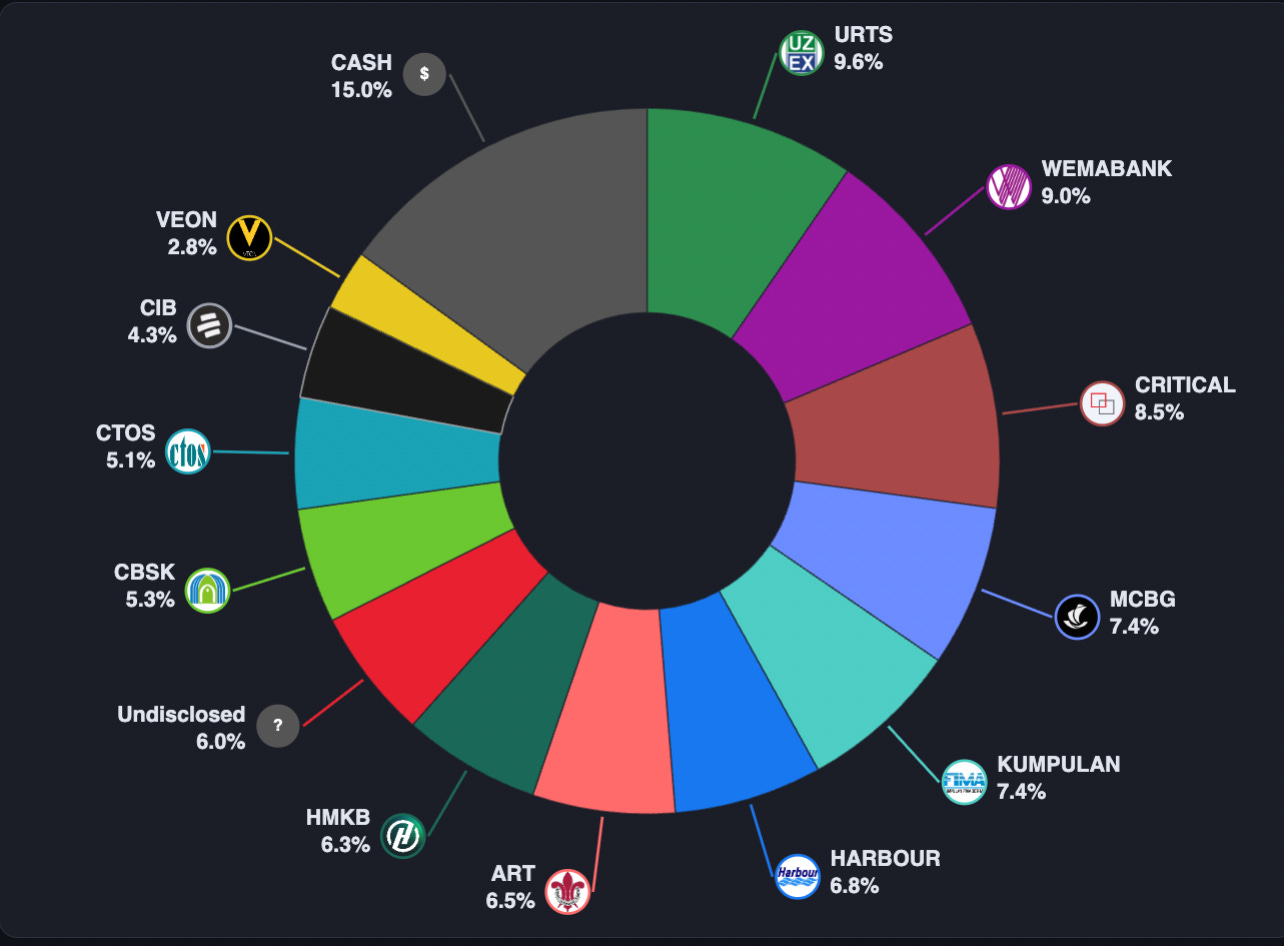
Pie chart:
Full details:
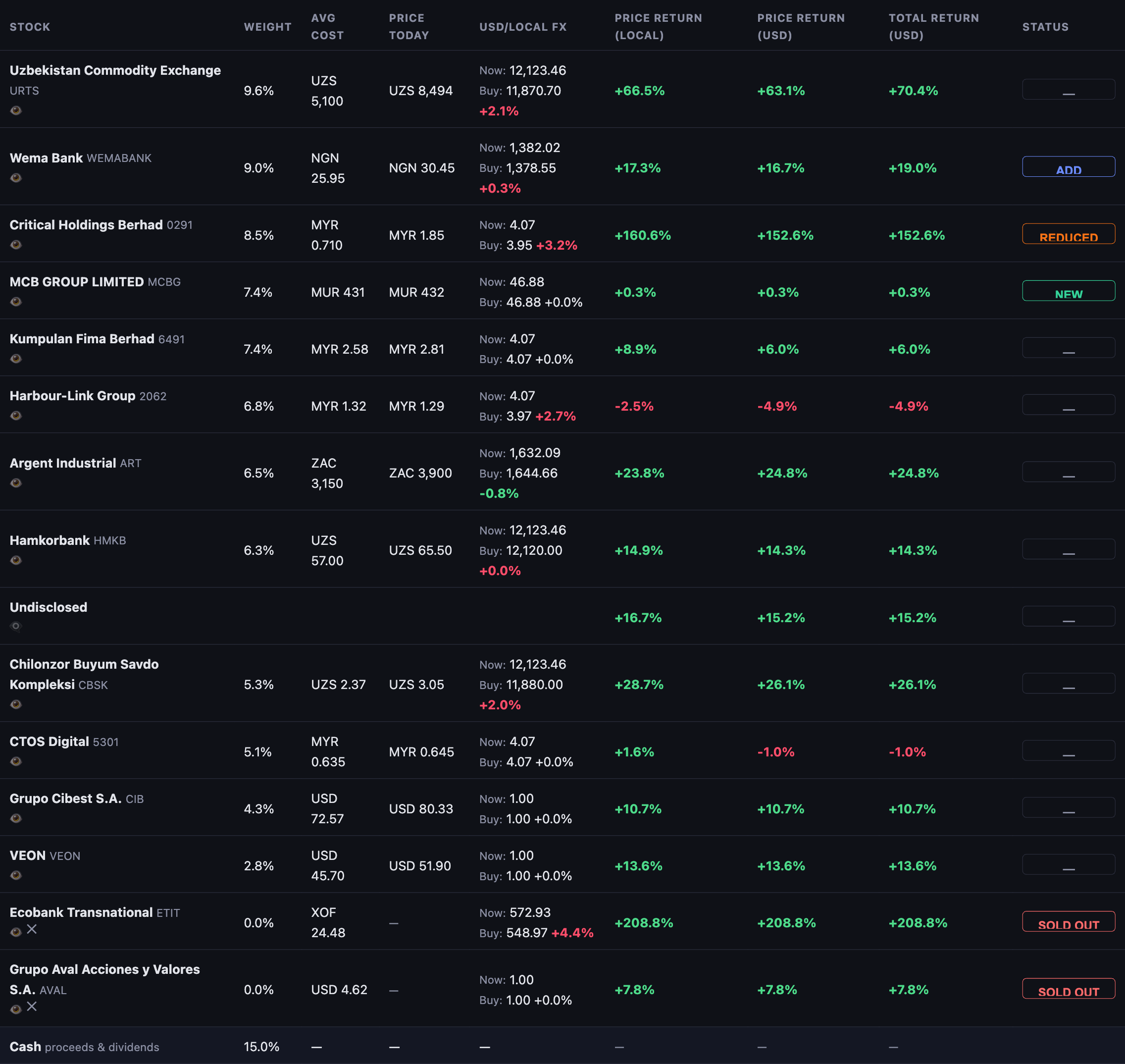
Sold Outs:
Ecobank Transnational (ETIT)
I was expecting to hold this for a few years, while it kept making money and its many problems - while not going fully away - started to be more under control. I expected dividends to arrive sooner or later and be a catalyst.
Instead, what happened was that dividends were announced in April this year, but they were so low that they disappointed the market, and the stock went down. I bought the dip.
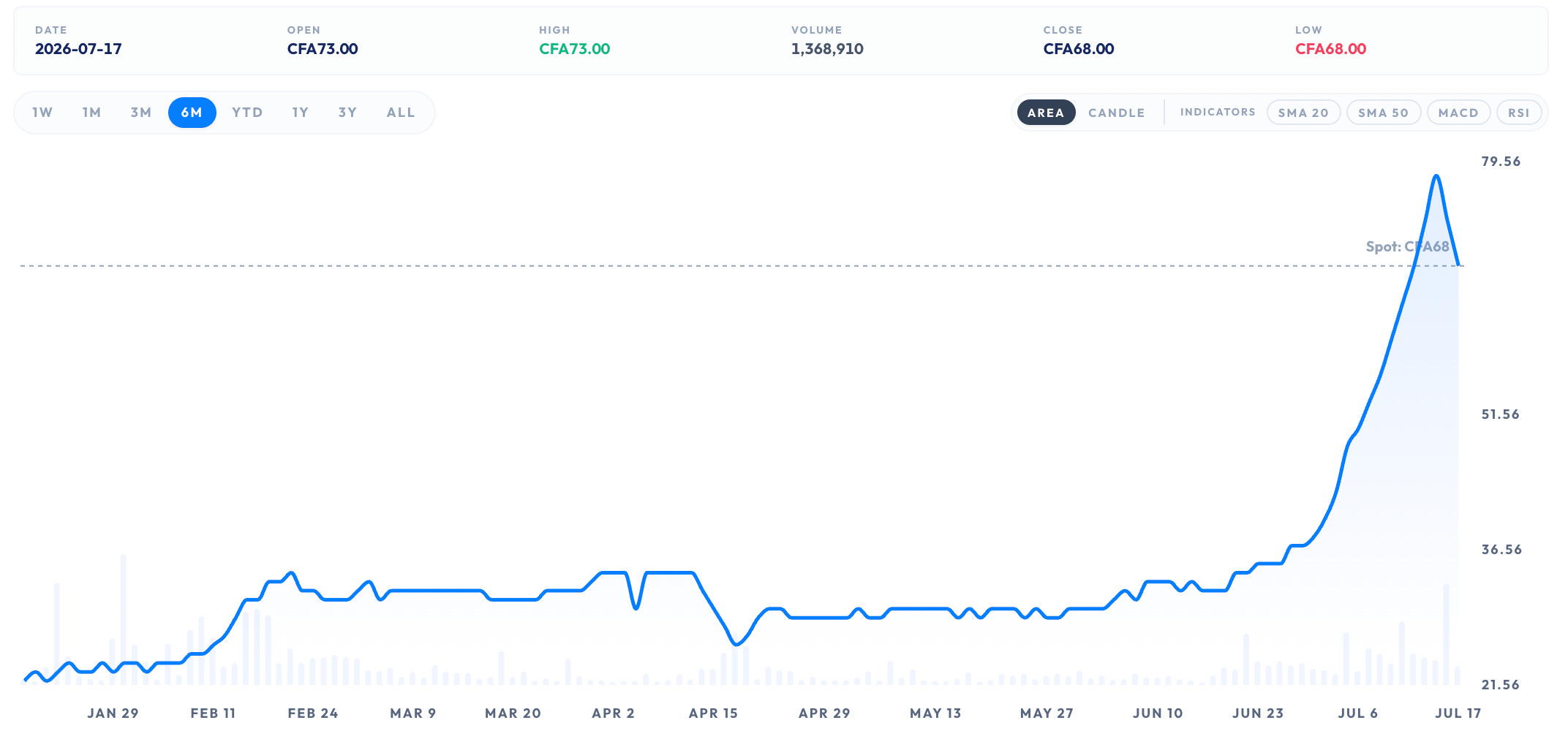
And then the last 3-4 weeks Ecobank’s BRVM listing (the one I own) has had this crazy run-up on no-news from low 30s XOF to 78 XOF. Up +115% in Abidjan/BRVM while falling in Lagos (-10%) and Accra (-6%) over the same four weeks. The Ghana listing was already priced much higher than the other two for reasons discussed in the Ghana post. So right now the three listings are as follows:

That puts the BRVM listing on roughly 7.5x attributable earnings. My original thesis for buying it was that it wasn’t the highest quality bank, but that it was profitable and crazy cheap at P/E 2, and that its problems were over-estimated.
Now, with a no fundamentals run up, it meets several of my sell criteria from Finding My Investing DNA, Part II. The thesis is no longer there at 7.5x (the cheapness was the thesis), it’s a too far too fast/trading for perfection (for an African bank that is a bit of a mess of a bank), and there are plenty of better opportunities than Ecobank at 7.5x.
So I sold. If it ever goes down to P/E 2 again, I’ll have a look again. And the Nigeria listing could possibly be interesting.
I’d like to have a single stock grow into a large percentage of the portfolio, and let it run without selling or trimming. But that has to be a high quality company, and Ecobank ain’t it.
Grupo Aval
So what happened in Colombia was that Abelardo de la Espriella won the election but with a very small margin (less than 1 percentage point). The outgoing president Petro has claimed fraud, refused to recognize de la Espriella and sought to nullify the result. De la Espriella in turn accused Petro of behaving like a coup-plotter ("golpista") and suspended the transition process - can't sit at the handover table while the other side calls you illegitimate I guess.
Totally standard Latin American politics in other words. Still, I thought I’d sell Aval, which is the weakest of the two Colombian names, and the one with the biggest downside if the Colombian electoral mess intensifies.
Since then, it seems Petro’s legal challenge hasn’t succeeded and the official count has so far been upheld by authorities. It looks increasingly likely that de la Espriella will be sworn in on the 7th of August. I’ll keep the other Colombian name - Grupo Cibest - in line with the original thesis that there is a significant upside even if de la Espriella isn’t a great president, it is enough if his government just stops the very worst existing policies.
Trim:
Critical Holdings
This one was a tougher one. Critical won a huge new order (likely from Lam Research) so thesis clearly isn’t broken, and had a fundamentals driven run-up. This trim is more in line with Ian Cassel’s “It went from… undervalued to trading for perfection… that’s a great time to sell.” and that one needs to sell microcaps faster than larger stocks.
The thing is, Critical Holdings is a cyclical microcap - an operating-leverage contractor - not a quality compounder. Hold-almost-forever works when a business has a moat plus somewhere to reinvest at high returns. A project contractor like Critical has neither: the backlog is a queue, and when the queue empties, earnings don’t decline, they cliff. At some point in the future the likes of Lam Research will cut down on capex, and then Critical’s orderbook will not be replenished.
Impossible to time perfectly of course, but I thought I’d trim a bit into the euphoria of a record order, instead of when Lam's guidance cracks.
Add:
Wemabank
There was a general Nigeria market pullback - nothing to do with Wema, so I bought the dip. Wema’s fundamentals are really great, it is accelerating: Q1 2026 PAT was 63.1B NGN, +76.1% year-on-year, interest income up 63% to 180B NGN, loans growing (1.86T, +7% in the quarter), asset quality improving.
I’m still somewhat concerned that the Nigerian macro will deteriorate, that the official-vs-parallel FX gap widens again, and that the Naira will start dropping significantly against the USD. But Wema is doing so well that it has a fair chance of outgrowing it.
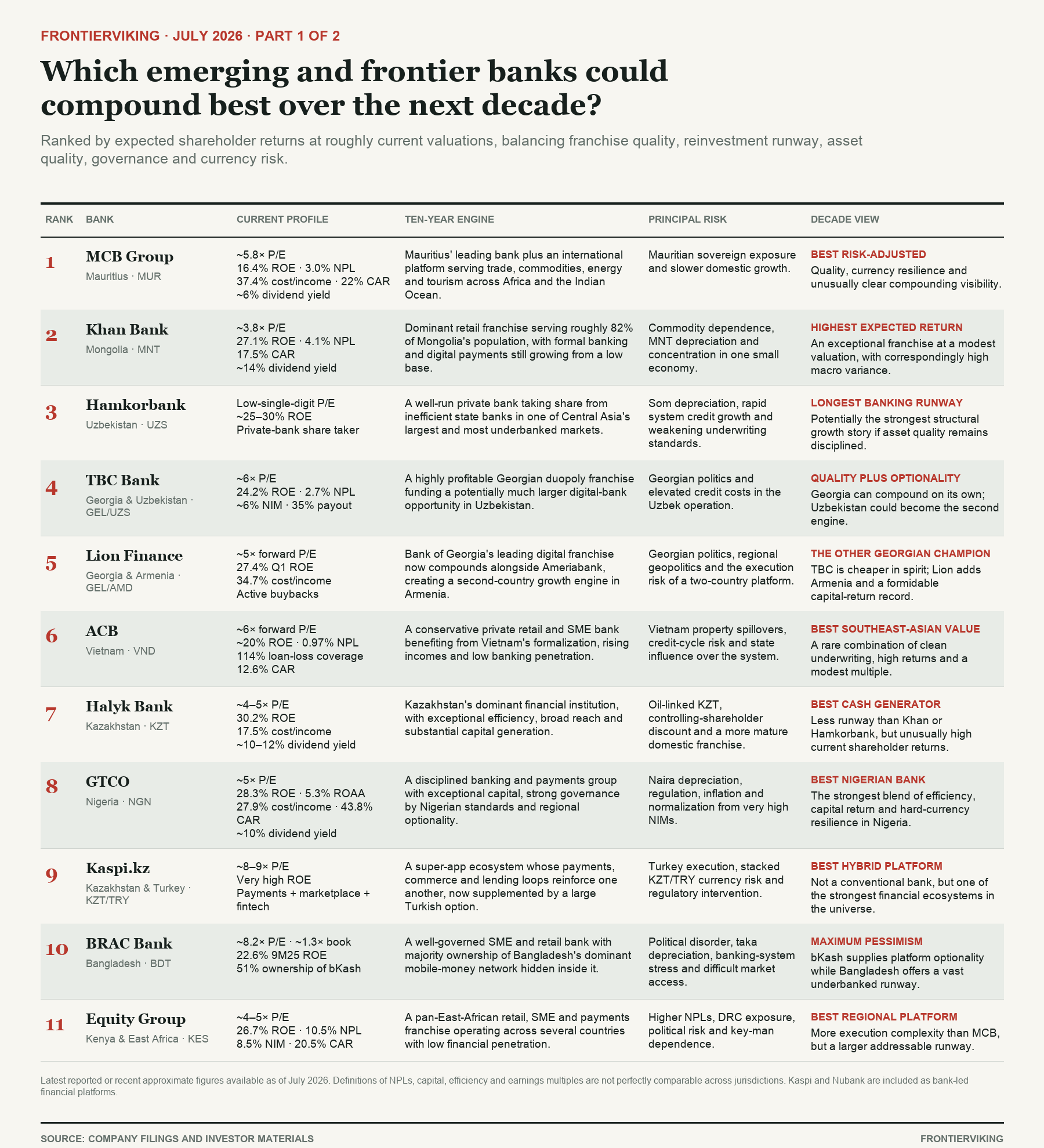
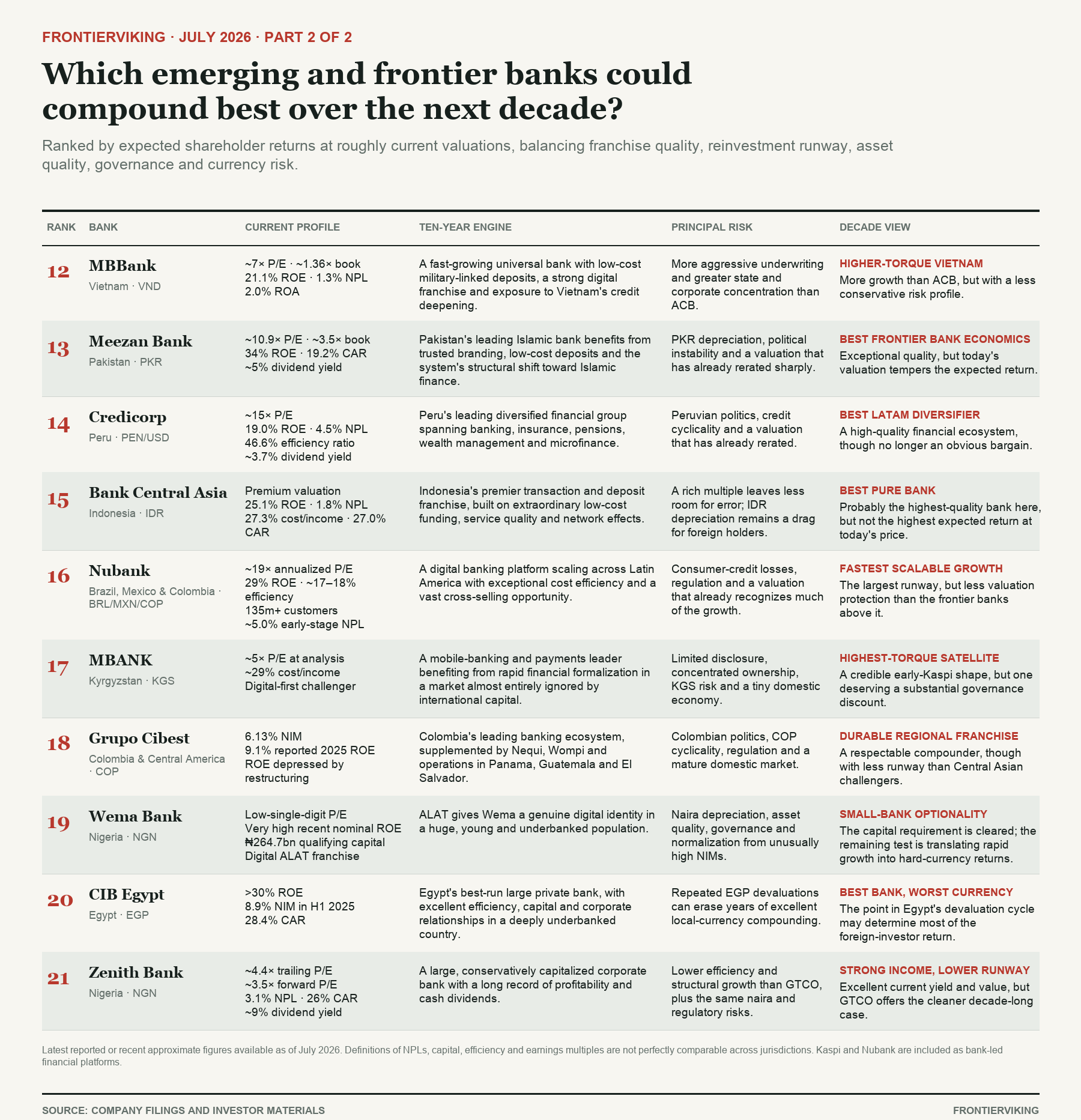
I had Claude Fable and GPT-5.6 Sol battling it out over which banks in my universe would give the best returns to shareholders over a 10-year horizon. For Wema the verdict was:
Wema has the highest upside if ALAT/fintech rails really scale and Nigeria stabilizes. It could beat everyone. But the 10-year distribution is wide: huge winner if Nigeria works, mediocre/dilutive if macro keeps eating equity returns. I’d call it the highest-beta contender, not the base-case winner.
New Position:
MCB Group
I took some of the Ecobank proceeds and bought MCB Group which is the largest bank in Mauritius. It is not really a domestic Mauritian bank though. Roughly 72% of profits are generated outside Mauritius in hard currency, largely through USD-linked corporate, trade-finance, energy and commodity-finance activities internationally across the Indian Ocean and Africa.
Specifically, the credit exposure comes from:
Oil and refined petroleum trading
Gas and energy flows
Agricultural commodities
Metals and other physical commodities
Import/export and inventory financing
Letters of credit and short-duration transaction finance
These are not predominantly risky local African SMEs. Many counterparties are traders and corporates domiciled in stronger jurisdictions but financing growing African/Indian Ocean trade:
North America: approximately 32% of cross-border exposure
Europe: approximately 26%
Sub-Saharan Africa: approximately 21%
Key metrics:
~5.8× earnings
~0.9× book value
~6% dividend yield, with 0% Mauritius withholding tax
~16% ROE
2%-3% NPL ratio, 88% coverage
17–20% Tier 1 capital
So this is a conservatively run, well-capitalized, internationally diversified bank with a clean ownership structure, priced as if it were a struggling domestic lender. The dividend has compounded at approximately 13.5% annually over 20 years. And while Mauritius is in Africa, its level of development and institutions and growth trajectory are way above the likes of Nigeria and the countries where Ecobank operates, and closer to a place like Malaysia.
As to why MCB Group is so cheap, it has to do with Mauritius. While a relatively well-run country, it has run a little too large deficits recently and is on the edge of being downgraded to below investment grade. I’ll dig deeper into this in a separate Mauritius post.
10-Year Horizon Toplist
Lots of bank transactions this month. The Wema verdict above was one slice of the Claude Fable vs GPT-5.6 Sol debate - here's the full ranking of which banks they expect to deliver the best returns over a 10-year horizon:
Impressive as usual - selling critical holdings is definitely a bold move, but will protect you from some AI volatility. Wemabank is very interesting to me as well.
Impressive! Keep up the good work. The total uniqueness makes it hard to give initiated feedback, but I like this!