
Stocks in Mauritius
A land bank that loses money, a monkey business that doesn't, and a lottery half the island plays every week

Going through the Mauritius stock market A-Z, and besides MCB Group, here are the stocks I found most interesting:
Almarys
Market Cap: 1.6B MUR (34M USD) at 3.84 MUR per share
Starting by the balance sheet, this is a company that owns a lot of agricultural land in Mauritius:
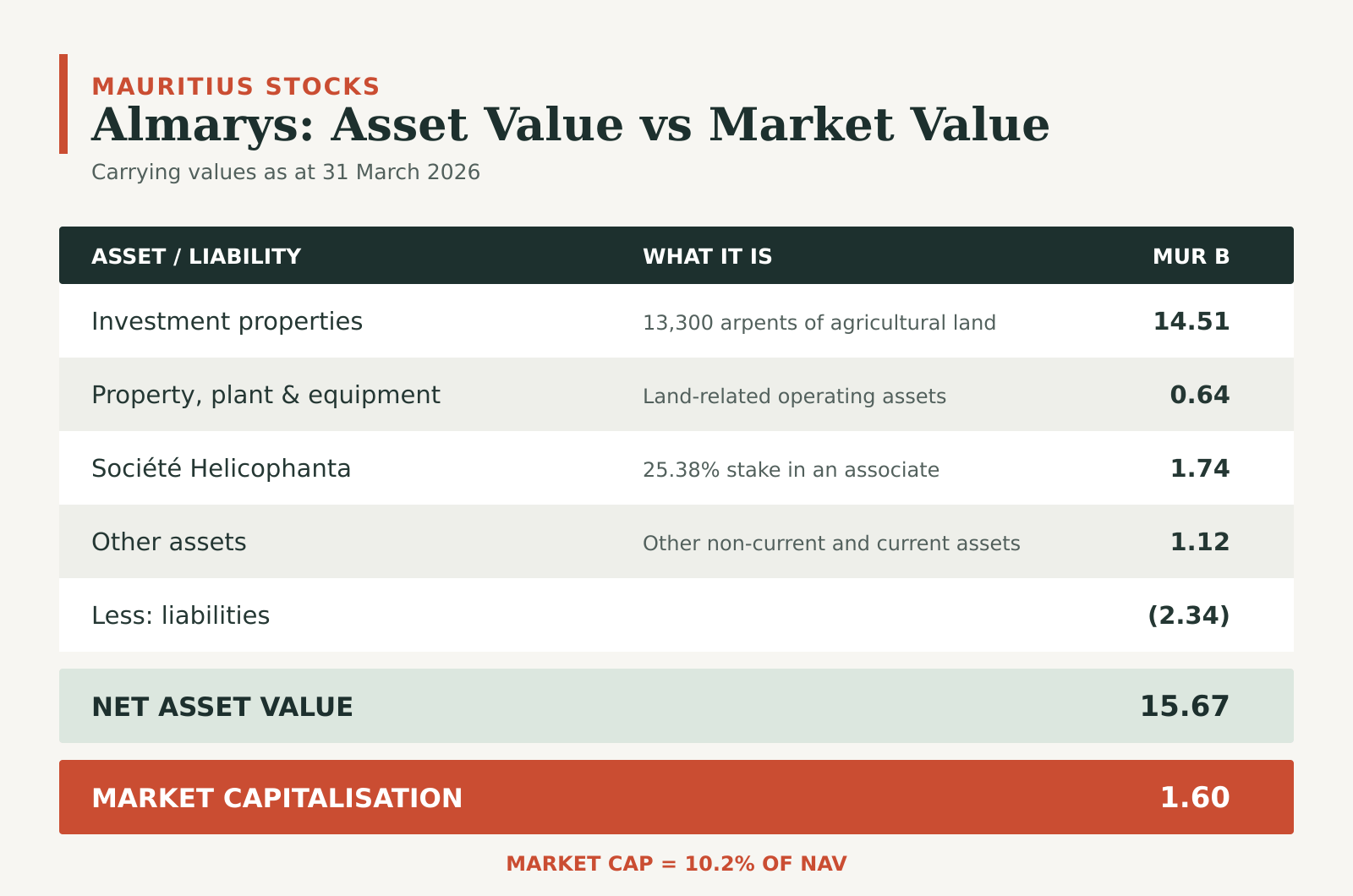
13,300 “arpents” is 5,600 hectares or 56 square kilometers, which actually is 2.75% of Mauritius’s entire land area. The land is currently earning rents from agricultural leases, mainly for sugar cane cultivation. At 14.51B MUR, that means Almarys uses a carrying value of MUR 258 per square metre.
I looked it up to see if 258 MUR/m² is in line with market prices of agricultural land in Mauritius in the two regions - Moka and Savanne - where Almarys owns land. As per https://www.propertycloud.mu/agricultural-land-for-sale/moka most prices are at 1000 MUR/m² or higher, so it seems 258 MUR/m² is very conservative. The cheapest I found was at 510 MUR/m².
So this means just the land - if sold piecewise - can be worth maybe as much as 20x - 40x of the market cap - ok, interesting!
Revenue and Earnings look as follows:
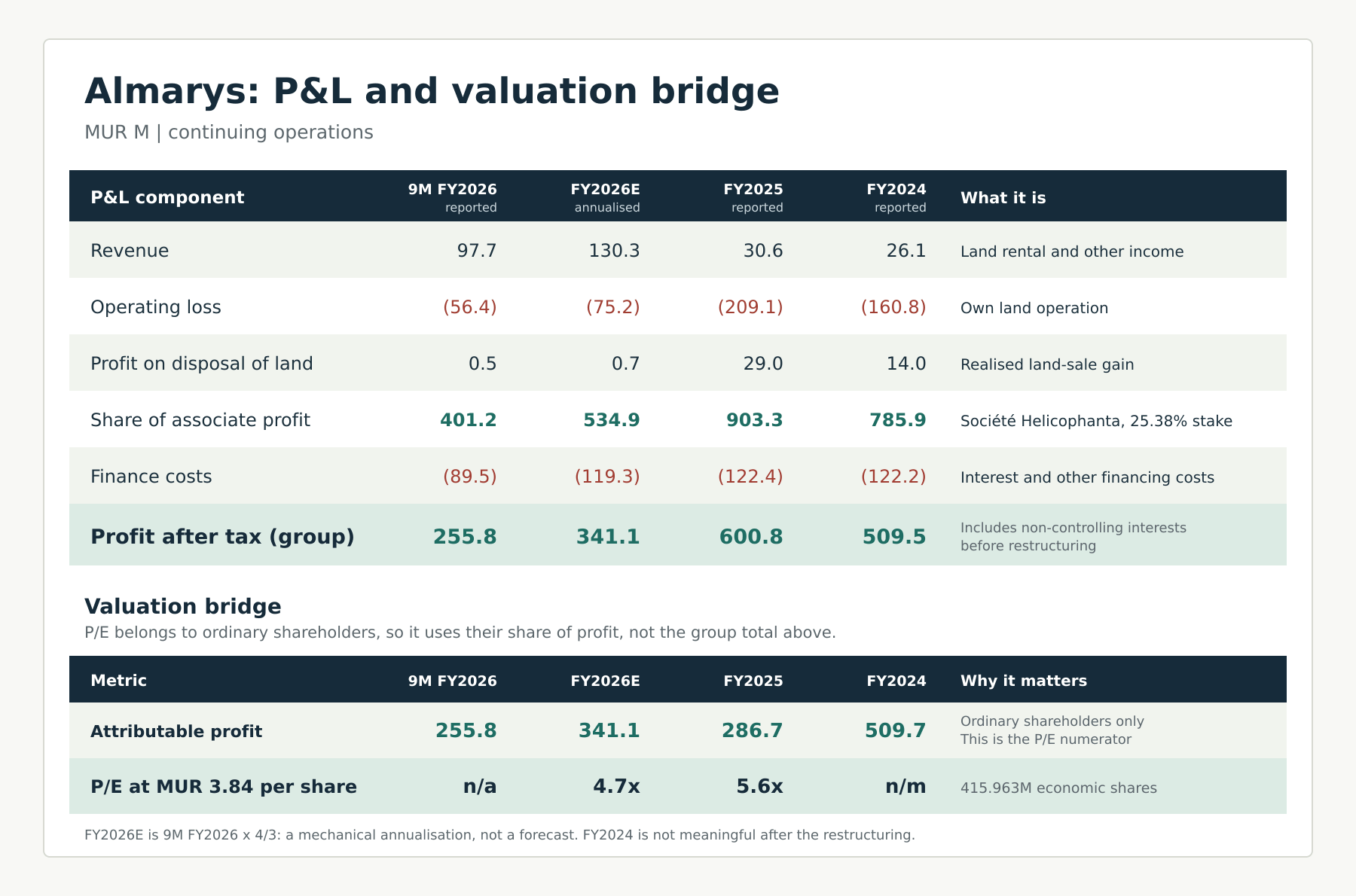
Wait, what!??
So they manage to consistently lose money on all that land, and the entire profit comes from their 25% stake in “Société Helicophanta” whatever that is.
Sugar cane cultivation is low rent low yield land use, but still, there is a listed Mauritian company called Union Sugar that manages to make a profit out of sugar cane cultivation. And Almarys is just owning and leasing out the land, I would expect that to be a profitable activity.
Looking into it further, I notice Almarys is leasing the land to ER Group - a much larger company created in a 2025 restructuring that spun off Almarys. And it appears Almarys as owner bears the estate-level costs: land and building upkeep, staff/administration, insurance, compliance, roads/drainage and the management infrastructure around the cultivation.
I would need to see the deal that Almarys has with ER Group, but it’s unfortunately not publicly disclosed. But it doesn’t look great, it looks like Almarys subsidises ER Group.
I’m reading [You Can Be a Stock Market Genius] by Joel Greenblatt and there he makes the case that spin-offs often are great investments. He shows the example where Marriott spun-off smaller “badco” Host Marriott holding the real estate assets and the debt, from “goodco” capital-light Marriott holding the brand and all the royalty income. Here the goodco Marriott extended a credit line to Host Marriott as part of the spin-off deal.
Similarly, it is possible ER Group and Almarys have a deal that isn’t fair on its own (like the credit line to Host Marriott) but makes sense as part of the spin off. But I would need to see the terms - is Almarys just going to lose money on the land to what appears ER Group’s benefit for the foreseeable future, or is it a temporary arrangement?
Almarys themselves say their plan for the land is to generate long-term rental income and preserve the land for long-term capital appreciation. So no catalyst there at all.
The Espitalier-Noël family now in the 5th generation owns 62.7% of the voting rights of Almarys (but only a small part of the economic share) so no activist shareholder can change things. And the same family also controls ER Group, confirming the related party / leakage to ER Group problem.
Société Helicophanta
Now, back to the mysterious Société Helicophanta. I asked Claude Fable what it was, and got this:
But the interesting part is what Société Helicophanta actually is, and I couldn’t resolve it. Almarys’ own site and every aggregator call it “a world-class biotech company” — which reads like an AI-generated profile error, and neither the Stock Exchange of Mauritius page nor almarys.mu gives any substance behind it.
I had to look at Almarys 2025 Annual Report directly, and in the company profile they say
Almarys now holds 13,300 arpents of agricultural land and a minority stake of 25.38% in Société Helicophanta, a company operating in the biotechnology sector.
As a key 25.38% shareholder with board representation, Almarys will contribute to the ongoing transformation of this company into a world-class biotech operator. Société Helicophanta has recorded high profitability in recent years, enabling the payment of significant and increasing dividends. Despite operating in an industry with high volatility and risks, Société Helicophanta has the potential to further increase its profitability and intrinsic value.
So it is not an AI profile error, they themselves label it a biotechnology company. But a very profitable biotech company, attached to a loss making land owning company? Weird!
The whole 258 page report is mainly about the land, and they never go into details of what kind of biotechnology Société Helicophanta actually does. I found a footnote on page 132 though, that says:
Société Helicophanta Primary Activity: Breeding and export of primates
Aha! Digging further it’s the Mauritian long-tailed macaque (cynomolgus) that is supplied for pharmaceutical and biomedical research.
All right, I see why they are not so forthcoming about it!
Many modern antibody drugs are designed to bind a precise human protein. If that target differs in mice or dogs, the drug may not bind there, making those species pharmacologically irrelevant for safety testing. Apparently cynomolgus macaques share enough of the relevant biology that the drug behaves more like it does in people; in some cases they are the only pharmacologically relevant species. Regulators can then accept a macaque study as the single relevant animal study before human trials.
The Mauritian ones command a premium because the whole population came from a handful of animals brought by sailors 400 years ago: they react identically to each other, and they never carried herpes B, the virus that makes Asian macaques dangerous to handle.
It is a magnificent - if controversial - business at the moment. Helicophanta has 54.8% net margins and 48.5% ROE which are not numbers one normally associates with breeding animals. And it earns in hard currency. Demand exploded after China stopped exports and Cambodian supply became entangled in smuggling cases, leaving Mauritius as one of the few clean sources of research primates.
The US FDA has a push to reduce animal testing which is a demand risk. But the effect is likely to be gradual rather than a cliff: shorter toxicology studies reduce days in the lab more than animals purchased, and when a biologic programme is allowed to use one species rather than two, it is often the macaque that remains. Gene therapy, especially treatments aimed at the brain and nervous system, also keep finding uses for primates
The more obvious danger is that current margins are due to a temporary shortage. High primate prices are encouraging new capacity: US company Charles River Laboratories has bought a rival Mauritian breeder, while Helicophanta is expanding breeding and quarantine capacity in Florida. That may be smart logistics, especially when airlines increasingly refuse to carry primates. It may also be the beginning of the usual commodity cycle, where extraordinary margins attract the supply that eventually removes them. Almarys’ reported P/E therefore looks less like 5x a normal earnings stream and more like temporary low P/E due to a macaque shortage.
On the other hand, the controversial nature of the business could reduce supply and keep margins high - like how tobacco has consistently high margins.
The Almarys Q3 outlook states Helicophanta will pay a reduced dividend while it funds the US build-out. Using debt to fund it.
Conclusion
What to make of this? If there was some catalyst for unlocking the land value, it would be a lot more interesting, but it seems they will just keep making losses on the land for the foreseeable future.
And the primate business - hard to predict. Feels like it should be a declining business over the long term as technology eventually makes animal tests less needed.
Now the primate business is doing well, and Almarys share price is still very low - so will the primate business ever cause a re-rating? Dividends are at a modest 4.3% - and much of the cash stays at Helicophanta used for an uncertain expansion.
It is a pass, but worth another look in the future, if there is more clarity about the deal with ER Group, and/or any indication they are selling land or converting land to more productive uses. Helicophanta doing badly could actually be a catalyst - without the Helicophanta money, they have to do something.
United Docks
Market Cap: 2.19B MUR (46M USD) at 90 MUR per share as at 31 July 2026
Next up, a business where absolutely no monkeys are hurt, we have property developer and property owner United Docks. They are focused on urban development in the capital Port Louis, and own the biggest portfolio of private freehold land in Port Louis plus 50,000+ m² of built area in Port Louis - offices, warehouses, conferencing venues, parking bays. They have ~70 tenants including listed multinationals and international institutions from 14 countries.
United Docks has clean governance, credentialled and genuinely independent-leaning board, a domain-perfect CEO, no extraction mechanism. There is no aligned founder/owner operator though - the business has existed for 168 years.
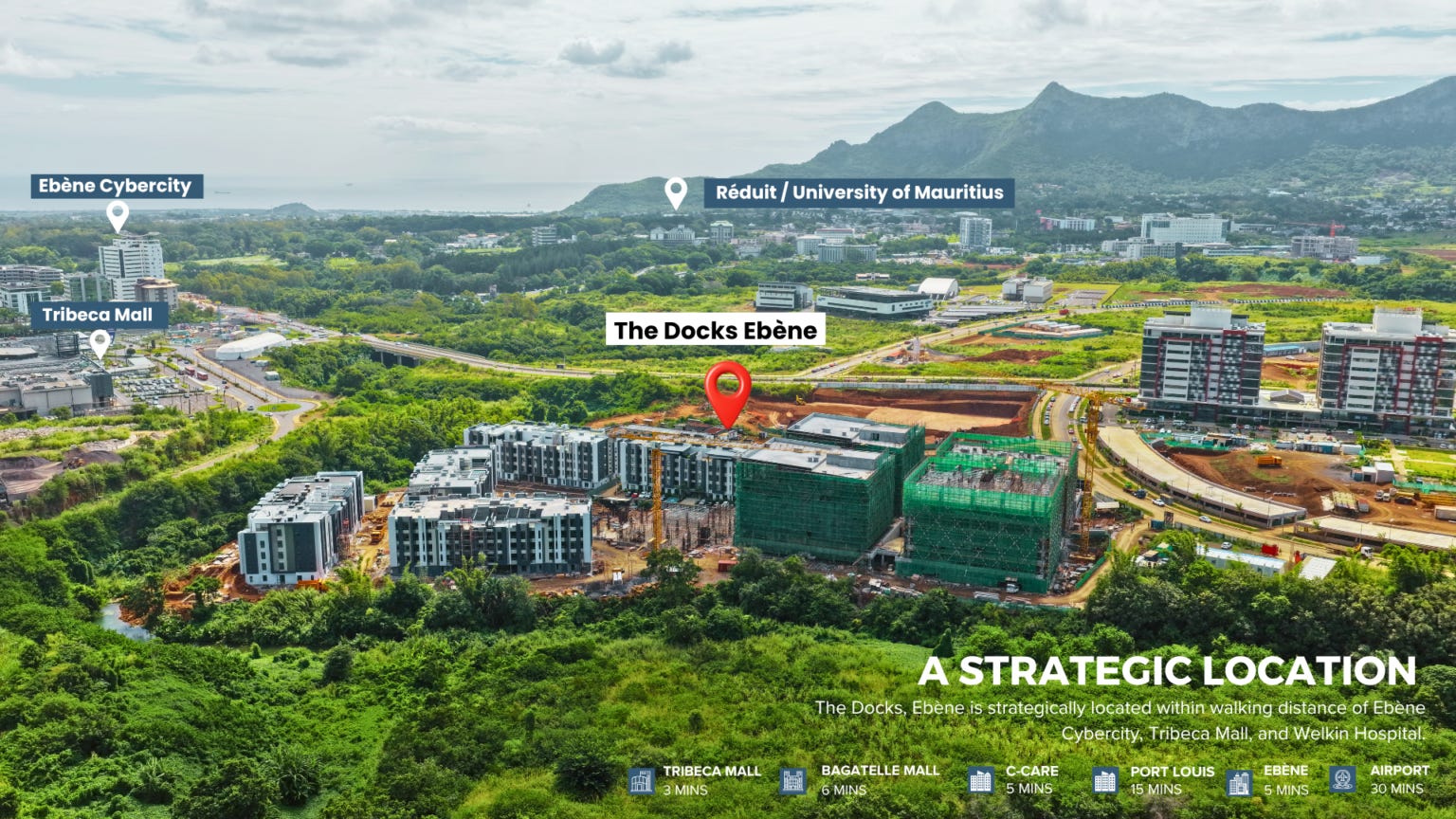
They are currently building The Docks Ebene - a 65,000 m² Smart City development comprising:
5 residential blocks of fully furnished serviced apartments
4 office towers
A multi-storey Wellness Centre, plus conferencing and entertainment amenities
The cumulative spend is estimated at 2.4B MUR by end of 2026. So yes, they are spending more than their entire market cap on this project, and it’s larger than everything else built up that they own. They financed this by selling shares in blue chip Mauritius companies they owned, and by taking on debt on existing properties.
The balance sheet and NAV vs market cap looks as follows:
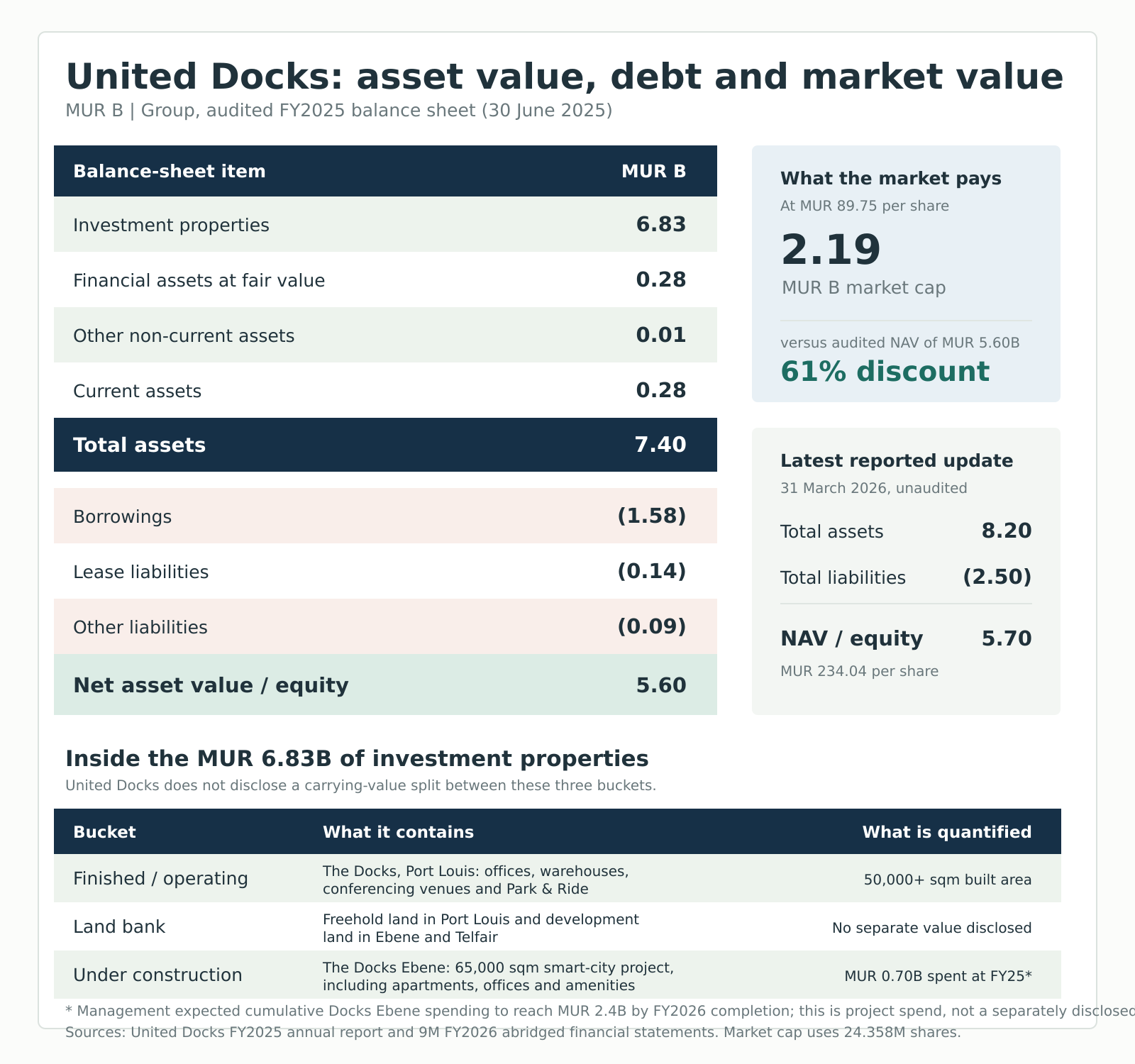
Property developers typically have a discount to NAV, but this is unusually large. And for being in the middle of a huge make it or break it project, the balance sheet looks pretty strong.
So how is Docks Ebene going?
They are selling the residential apartments, but keeping the management of them, and keeping and renting out the offices and the wellness centre.
They are estimating to earn 2.5B MUR by selling the apartments, and the whole thing including office towers and wellness centre is estimated to cost 3B to build. These things have a tendency to be delayed and run over budget though. The situation as per their March 2026 results is:
Block 1: completed enough to be launched for sale; by March, management said more than two-thirds had firm reservations and expected it to be fully sold by 30 June.
Blocks 2 and 3: described in recent company marketing as nearing completion.
Other residential blocks, four office towers, wellness centre and shared amenities: still in build-out / fit-out. The full 65,000 sqm estate is not complete.
The FY25 annual report targeted completion by late August 2026. By the March 2026 results, the stated target had become end-2026. So we have roughly a four-month delay so far. On the other hand the CEO of United Docks posted on linkedin, also around March 2026, that it would be ready by September 2026.
As a base case for the post-completion business, assuming 90% office occupancy, MUR550/m² per month in rent, a 65% office EBITDA margin, and modest income from the wellness centre and property management, I get recurring net profit of roughly MUR293M, or a 7.5x forward P/E. This excludes profit on apartment sales, which I treat as debt repayment.
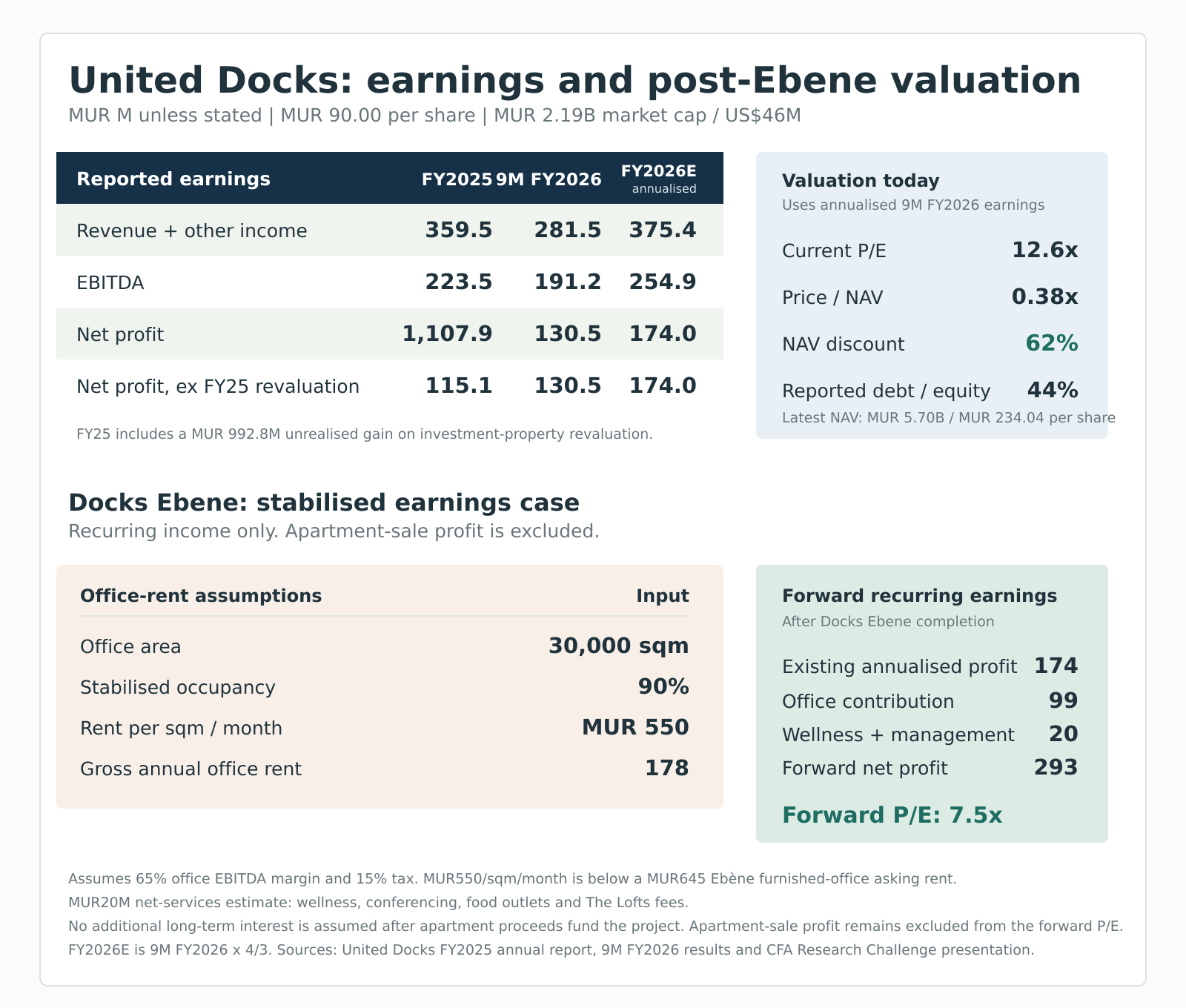
The near term will look worse than the business is, because United Docks is funding and finishing Docks Ebene while its financing burden runs through the accounts, but revenue and profit from apartment handovers will only be recognised later.
But if those units settle at anything near current prices in the area around Docks Ebene , three things happen at once: a real buyer, rather than an appraiser, puts a price on part of the development; the debt gets repaid; and the recurring rental base roughly doubles - and the market can no longer value it as an unfinished development with uncertain economics.
And longer term United Docks is in an irreplaceable position in the capital - and will do well, if Mauritius as a whole does well - causing property land values and rents to go up.
Conclusion
It’s a great bet on Mauritius’s economy, plus more asymmetric upside in the short term than other Mauritian property companies. It has some execution risk, and does earn in local currency, so suffers MUR depreciation. Would be a great buy if Mauritius has a minor fiscal crisis, preferably while Docks Ebene is till up in the air - but such perfect timing is unlikely to be available.
Interesting, but not an obvious buy. For the watchlist.
Lottotech
Market Cap: 1.59B MUR (34M USD) at 4.69 MUR per share as at 31 July 2026
Lottotech holds the exclusive licence to operate the Mauritius National Lottery on behalf of the Government, won through competitive tender in April 2009. That exclusivity has been renewed twice and now runs to April 2039.
The “tech” in the name is a misnomer, Lottotech is a pure operator, and they buy all their tech from third-party lottery-technology provider Brightstar Lottery. One upside here is that the classic lottery-sector conflict - a controlling shareholder selling systems to the listed operator at inflated prices - doesn't exist here, as Brightstar is a third party with no stake in Lottotech. Related-party flows are only about 0.1% of revenue.
What they do have beside the national lottery license is a retail network of 680+ agents, brands - Loto, Loto Plus, Hot Picks, and Loto Vert, plus exclusive Football Pools distribution rights for Africa, and since recently the remote communications licence for online and mobile in Mauritius.
The Mauritius government is the largest individual shareholder of Lottotech via the State Investment Corporation that holds 18.75%. So this is a cash cow for the government, which helped with the recent license renewal.
Lottotech reaches about 600,000 unique customers every week on an island of 1.26 million people. That's close to half the population playing weekly.
I recognise that it is a great business, but I admit that I don’t quite see the appeal from a player perspective. Sports betting ok, that can make watching sports more fun, but a pure numerical lotto with a very negative expected value - some say it is a tax on stupidity.
The numbers:
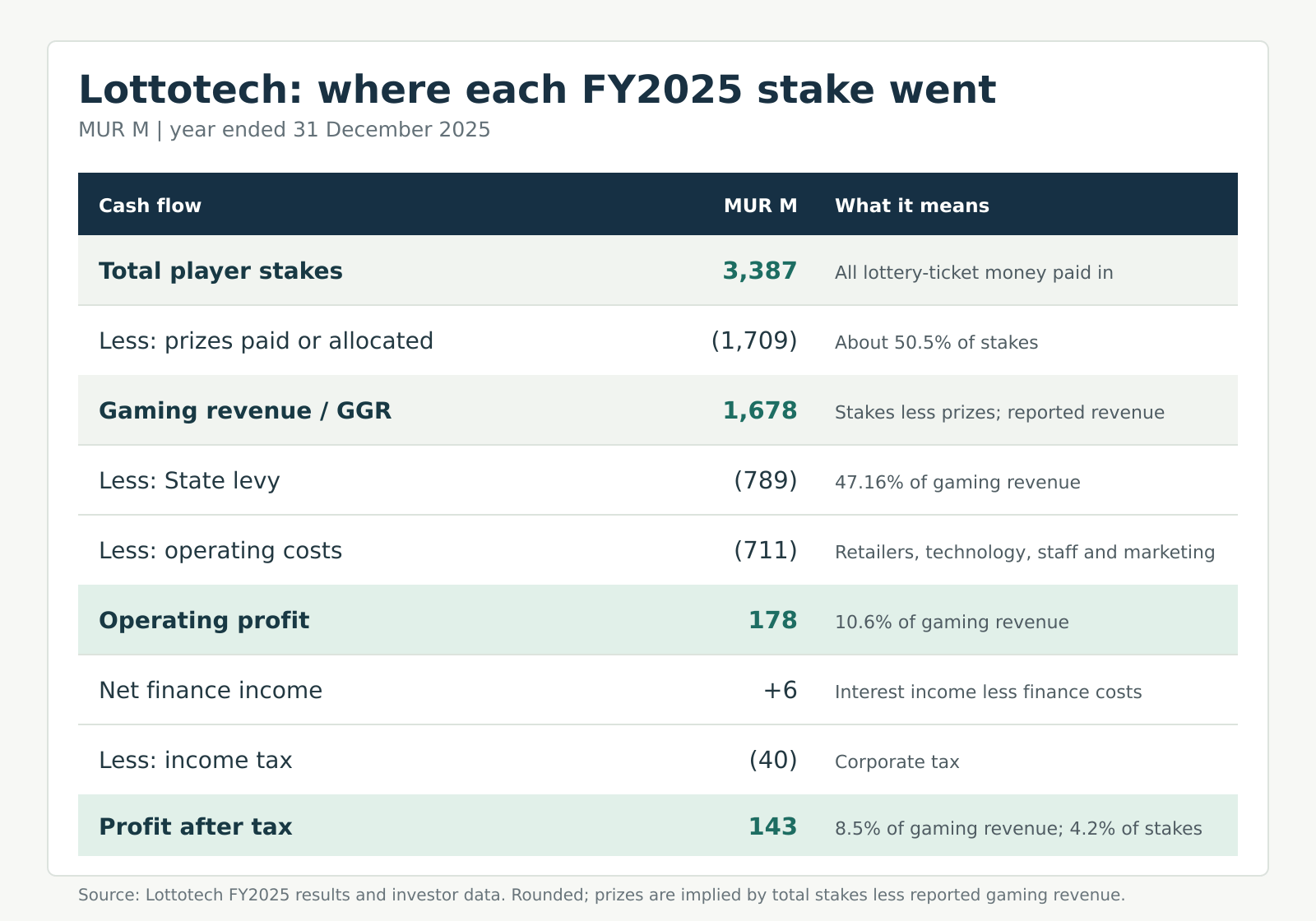
Tax isn’t a bad description, out of the 3,387 M MUR players put in, the state gets 789M in levy, 40M in corporate tax, and as owner the state also gets 18.75% of the 143M MUR profit. Additionally the state taxes winnings above 100,000 MUR by 10%, and of course taxes Lottotech employees’ salaries.
So the net impact of Lottotech is basically that half the population of Mauritius voluntarily give a lot of money to the state every year.
Even if the state takes the biggest part of the pie, it might not be bad to be a shareholder.
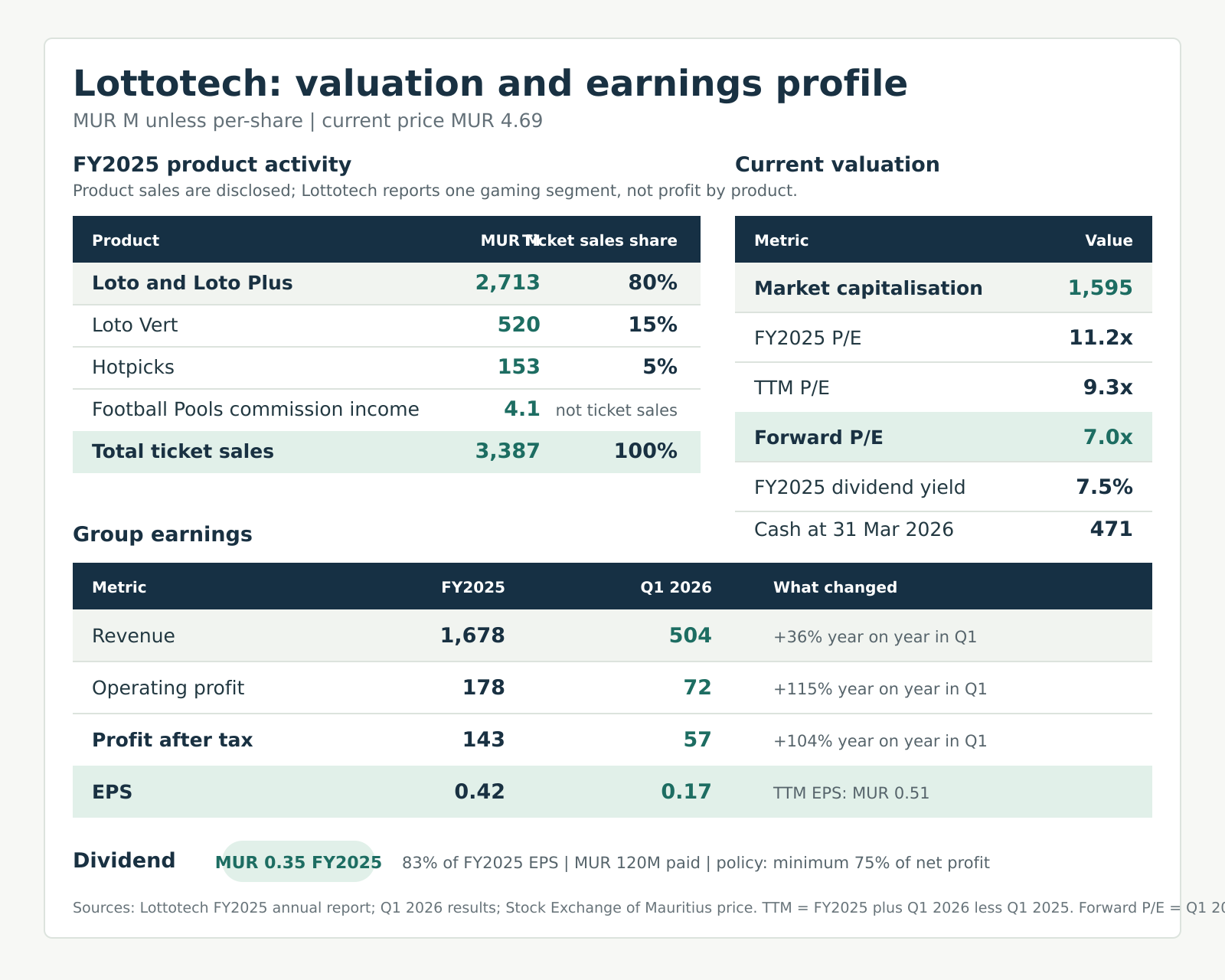
Surprisingly strong growth for what I expected to be a stable bond-like business. It’s three things causing it: a ticket-price increase in December 2025, favourable jackpot cycles driving more play, and strong operating leverage. Revenue rose 36% in Q1, but the cost base barely moved, so operating profit rose 115% and net profit 104%.
Players seem price insensitive - they want that jackpot. The fitting Buffett quote is:
"If you've got the power to raise prices without losing business to a competitor, you've got a very good business. If you have to have a prayer session before raising the price by 10%, then you've got a bad business."
This is a very good business - no doubt about it. And at current valuation the forward dividend yield could be 10-12% if the higher ticket price and Q1 profit run-rate broadly hold through FY2026. And the unlike everything else related to Lottotech, the dividend is actually not taxed by the Mauritian government as they have zero withholding tax.
The main risk here is basically the macro - and the dividend is a decent cushion for a depreciation of the MUR. Maybe another risk is if the government wants to take an even bigger slice of its already enormous take.
Conclusion
Yeah I mean, this is a buy now, and a fantastic add if Mauritius has a fiscal crisis. And it is a potential cash replacement in the portfolio. Not a perfect one as the Mauritian currency could drop a bit, but Mauritius is a sensible enough country that I can take that risk.
I think Lottotech is the first “slow grower” in the FrontierViking portfolio as per Peter Lynch’s classification by the way. This was a category Lynch avoided except if the yield was exceptionally high and safe which is precisely the case for Lottotech (in MUR at least).
Slow growers: mature companies with limited reinvestment opportunities. The shareholder return is mostly dividends, so the payout ratio, licence durability and balance sheet matter more than a clever growth forecast.
And ok, Lottotech has fast growth this year, but I don’t think that will hold up - they really have nowhere to expand. Except with the African Football Pool business, but that seems very small.
Nice write up. Fair play on the digging for the monkey company. That is wild!
appreciate any note in posts if\when any names ever have a liquid american\ADR listing.
(i realize ~95% will not)