
Mauritius
Remote, Well Run, and Slightly Broke

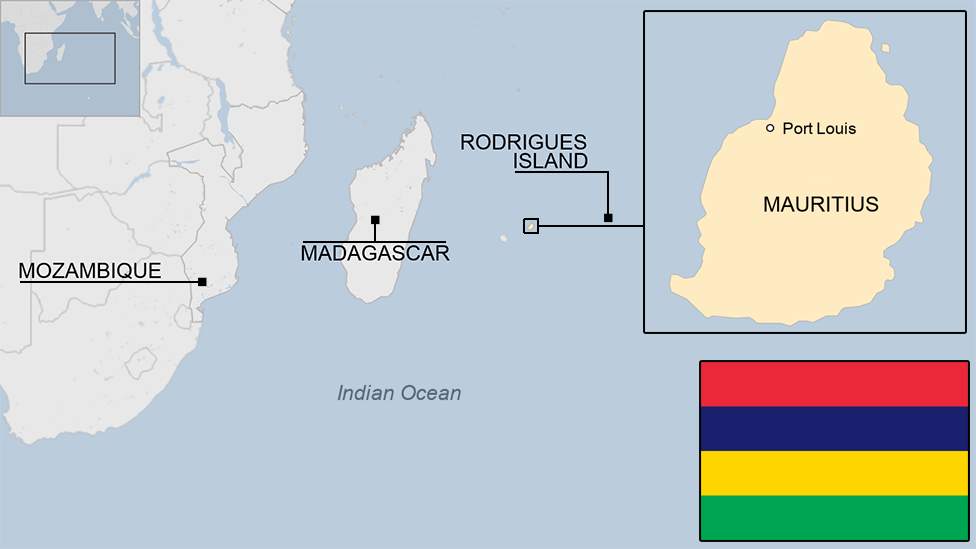
I’ve recently been looking at Mauritius - an independent island nation of 1.3 million people situated east of Madagascar. It’s one of those countries scoring well on the Lee Kuan Yew screener - no crisis, and steady long-term growth and improvement, coupled with a quite inexpensive stock market.
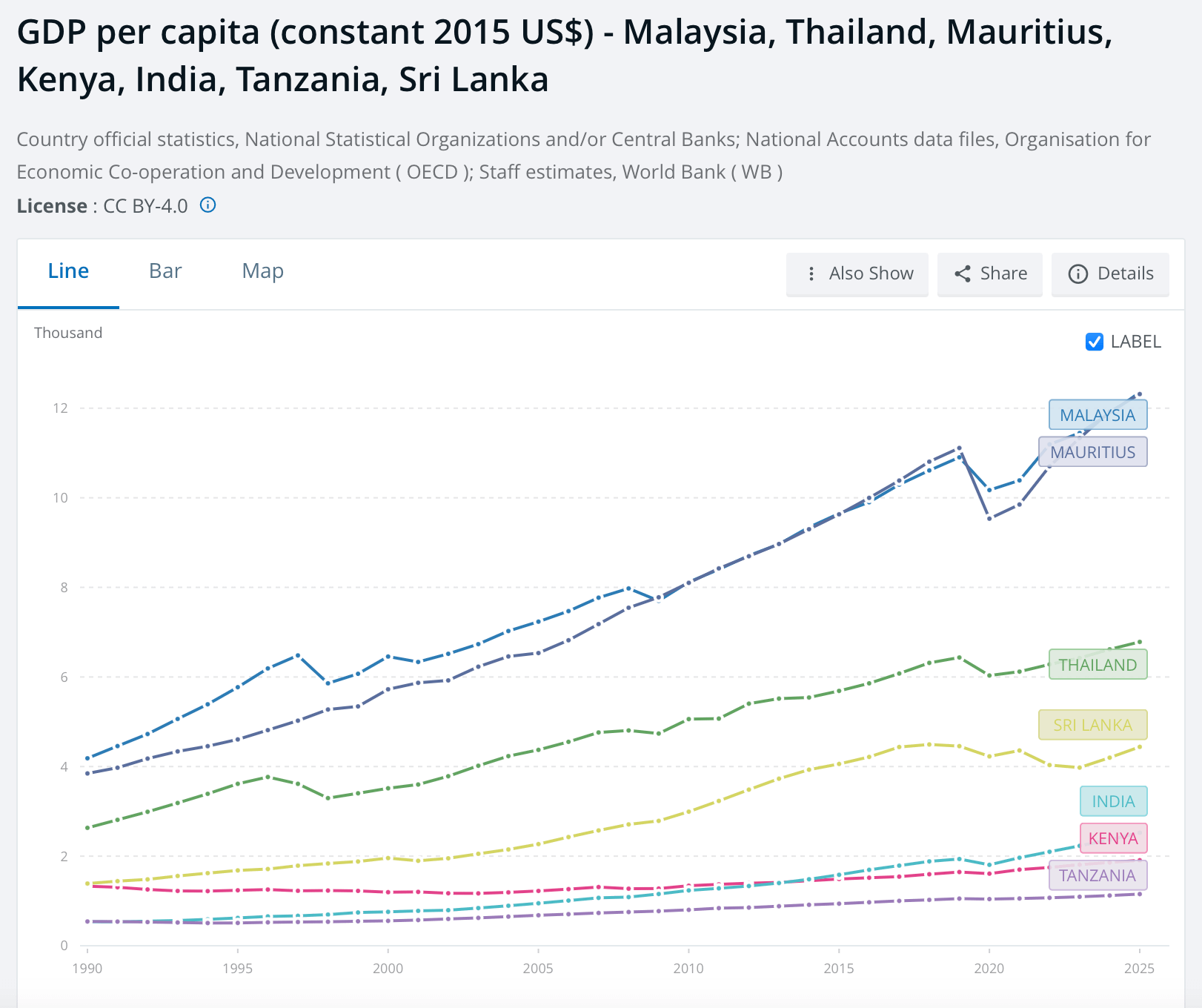
Looking at the growth trajectory of Mauritius since 1990, it’s basically a carbon copy of Malaysia’s growth which is really good. Mauritius is way ahead of other African countries and ahead of select other Indian Ocean-facing countries:
Unlike Malaysia, Mauritius’s population isn’t growing. Births exceed deaths, but migration is net negative dwarfing the birth-death contribution. Younger and skilled Mauritians leave for larger career markets, higher wages, study and lifestyle opportunities, especially in Europe, the UK, Canada and Australia. Mauritius does bring in foreign workers, expatriates, retirees and investors, but currently not in sufficient numbers to offset the outward flow.
I kind of see an opportunity here. Safe, well-run, low tax, strong rule of law, open city states are very attractive. With China taking over Hong Kong, and Dubai being in a warzone, there is kind of only Singapore left, and Singapore has made immigration progressively more difficult.
With nearly half of Mauritius’s population living in the Port Louis-Curepipe urban corridor and the hinterland being small it is practically a city-state. It does have decent institutions, low tax, business friendly climate, easy immigration, tolerance from being a multi-ethnic society and is quite safe. And it is absolutely gorgeous too.
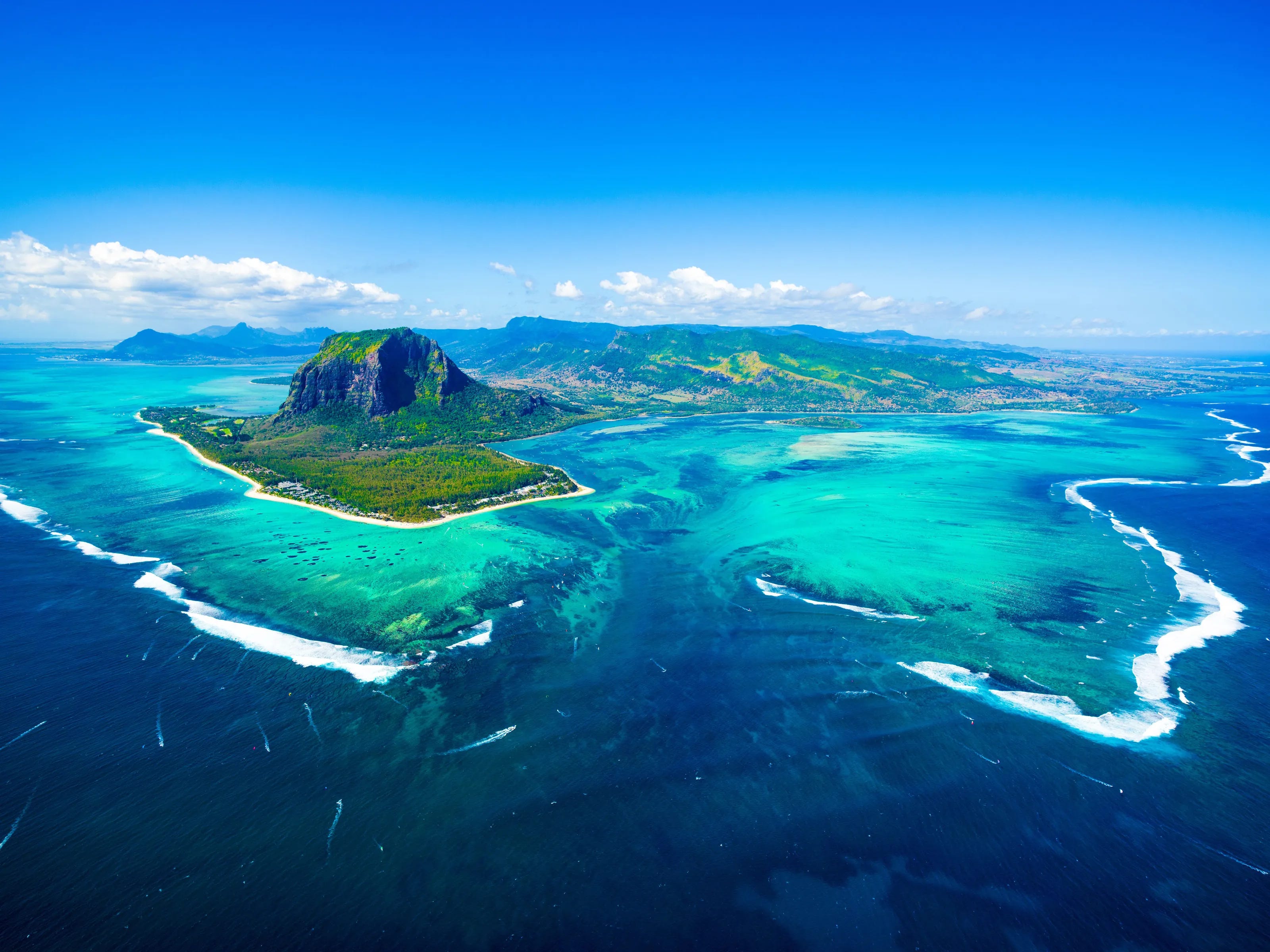
Its location is very remote though, far off and a long flight from everything. But it didn’t use to be - in the age of sail it was right on the main route between Europe and Asia, and fought over by the Dutch, French and British. Britain captured it from France in 1810 during the Napoleonic Wars, but let the French settlers keep their land, language, Catholic religion and legal system (though mixed with common law now). So the descendants of the French settlers - even if comprising just 1-2% of the population - are still the economic elite of the island, controlling many of the listed companies on the Mauritius stock exchange.
The island was uninhabited before the Europeans reached it, so there is no native population. About 68% of the population are Indo-Mauritians - descendants of indentured servants brought in from India by the British Empire. This group now dominates politics. And then you have 27% Creole (Madagascar/African mix) who are descendants of slaves brought in by the French, and about 3% of Chinese descent who came by choice mainly as traders.
Back to that remoteness, I’m thinking the remote location might turn into more of an advantage than a liability - it is far away from Iran for example, and generally insulated from geopolitical risks.
I can totally see Mauritius seeing an influx of entrepreneurs and High-Net Worth Individuals (HNWI), and even if not entirely matching Hong Kong, Dubai or Singapore - at least being in consideration as it has many of the qualities that made those places attractive.
In fact, as per Henley & Partners wealth-migration report, Mauritius was projected to attract 100 HNWIs in 2025, and I would expect this trend to keep increasing. The most famous HNWI resident of Mauritius is by the way probably Terry Smith of Fundsmith. Incoming HNWIs and entrepreneurs have tremendous positive externalities in terms of value creation, skill transfer, business and job creation, real estate value increase and start of cluster/network effects.
So a plausible path forward is that Mauritius keeps getting richer, attracts more and more HNWIs, more local opportunities are created so the youth stays to a greater extent, and net migration turns increasingly positive.
Inflation, Currency and Rates
The macro picture is decent, though not perfect. The Bank of Mauritius raised its key rate from 4.5% to 4.75% in May 2026 in response to renewed inflation risks. Year-on-year inflation was only 3.7% in June, but the IMF expects headline inflation to accelerate to 6.4% by December.
The Mauritian rupee (MUR) floats, and is freely convertible for investment purposes. Mauritius abolished exchange controls in 1994, and foreign investors can convert and repatriate dividends, sale proceeds and capital without approval or formal limits. Practical liquidity and bank spreads still exist, but this is not Nigeria: there is no official versus black-market exchange rate and no obvious danger of getting trapped in the currency.
The MUR currently trades at around 47 to the US dollar. It has been roughly stable against the USD since the end of 2024, after depreciating 6.7% during 2024, and has lost about 16% of its dollar value since 2020. So this is a steadily slowly depreciating frontier-market currency, but not currently a currency crisis.
Mauritian Politics and Fiscal Woes
A funny thing with Mauritian politics is that a party’s name doesn’t necessarily have any bearing on its political orientation. Basically all Mauritian political parties emerged from the same anti-colonial and trade-union milieu, so they typically have left-coded names.
What actually organises Mauritian politics is ethnic coalition-building and patronage, not ideology: elections are won by stitching together the Indo-Mauritian Hindu majority with enough of the smaller communities, and parties function as patronage vehicles rather than idea carriers.
Up until 2024 the MSM - Militant Socialist Movement - was in power, and this party has historically been pro-business and economically liberal, and classified as centre right. MSM drove the 1980s liberalisation that turned the export zones into a textile boom, built out tourism, and created the offshore financial-services sector.
Then recently (2017-2024) MSM drifted somewhere else again - not liberal, not socialist, but populist: universal pension increases, large state infrastructure (the Metro Express), heavy public-sector pay growth, off-budget deficit spending, and with an authoritarian turn in ordering a national social media shutdown ahead of the 2024 elections.
Nevertheless, the 2024 elections were won in a landslide by an opposition coalition led by the Labour Party - nominally centre-left. Under elected PM Navin Ramgoolam the coalition opened the books on its predecessor and revealed a deficit far worse than reported (9.3% of GDP) and a government pension scheme that spent 44.6B MUR and has nothing left. The IMF’s technical assistance confirmed the concealment was real but, importantly, found no falsified debt data. Debt is at 88% of GDP [and overwhelmingly denominated in MUR].
Mauritius is by the way one of only three African countries with an investment grade rating (the others being Botswana and partially Morocco), and Mauritius is on the edge at the moment, Moody’s has it at Baa3 with negative outlook - the lowest possible investment grade rating.
And I guess this is why Mauritius keeps its investment grade: even in the worst case, the debt numbers themselves are real (unlike say Senegal that had to revise debt dramatically upward recently) - and every so often the opposition comes in and opens the books.
The new government has been quite fiscally responsible and pragmatic. They have cut a range of subsidies and allowances, increased some taxes (passenger levies, extra taxes on financial services) while still keeping a business friendly climate and courting foreign capital, and foreign people via the Work & Live programme. They got the deficit down to 6% for the July 2025 to June 2026 fiscal year, and were projecting 3.7% for the current fiscal year under the assumptions that they get the Chagos island money from the UK and introduce means testing of pensions. However, they had to back down on the means testing of pensions due to public backlash (Mauritius has a median age of 38.5 years vs 19 for sub-Saharan Africa, and old people vote).
So the fiscal situation is still a problem, and they are on an unsustainable path, and there is a risk of a credit downgrade below investment grade.
I see it this way: if they do have a fiscal crisis and even a downgrade, it will be a great investment opportunity. The fiscal crisis will give the political capital to do the necessary unpopular actions, while the long term growth trajectory stays strong.
And in the more likely event they’ll just muddle through without a fiscal crisis, supported by growth, possible tax increases and continued inflows of foreign capital, Mauritius currently offers an interesting market with lots of inexpensive, reasonably high-quality companies with good long term prospects. And it’s one of few countries with zero withholding tax on dividends along with the UK, Singapore, Malaysia, Hong Kong, Kazakhstan and Uzbekistan.
I note that Mauritius’s fiscal problems are very first world-y, and their long term trajectory is unlikely to be affected. Unlike say France or Italy that have structural fiscal problems with too high debt, low growth, pensioners taking an increasing share of tax revenues, and terrible bureaucracy and maxed out taxes, Mauritius’s problems seem eminently fixable. Cut spending just a little bit more or get a lot of entrepreneurial/rich foreigners to come to your island and you might not need to cut spending at all.
—
Public announcement: I’ll be speaking at the Weird Shit Investing Online conference, Tuesday 28 July https://www.undervalued-shares.com/events/weird-shit-investing-online-2026/
FYI, adopted home of fundsmith founder , terry smith. (for taxes?)
decided what they really needed was...a car museum.
https://bizweek.mu/we-want-to-build-the-best-car-museum-in-the-world/lifestyle/