
Malaysia
Truly Asia

In further attempts to find something for the portfolio in Southeast Asia, I’ve been looking at Malaysia. It’s arguably more of an emerging than a frontier market, but I never said I’d limit myself to only markets officially classified as frontier!
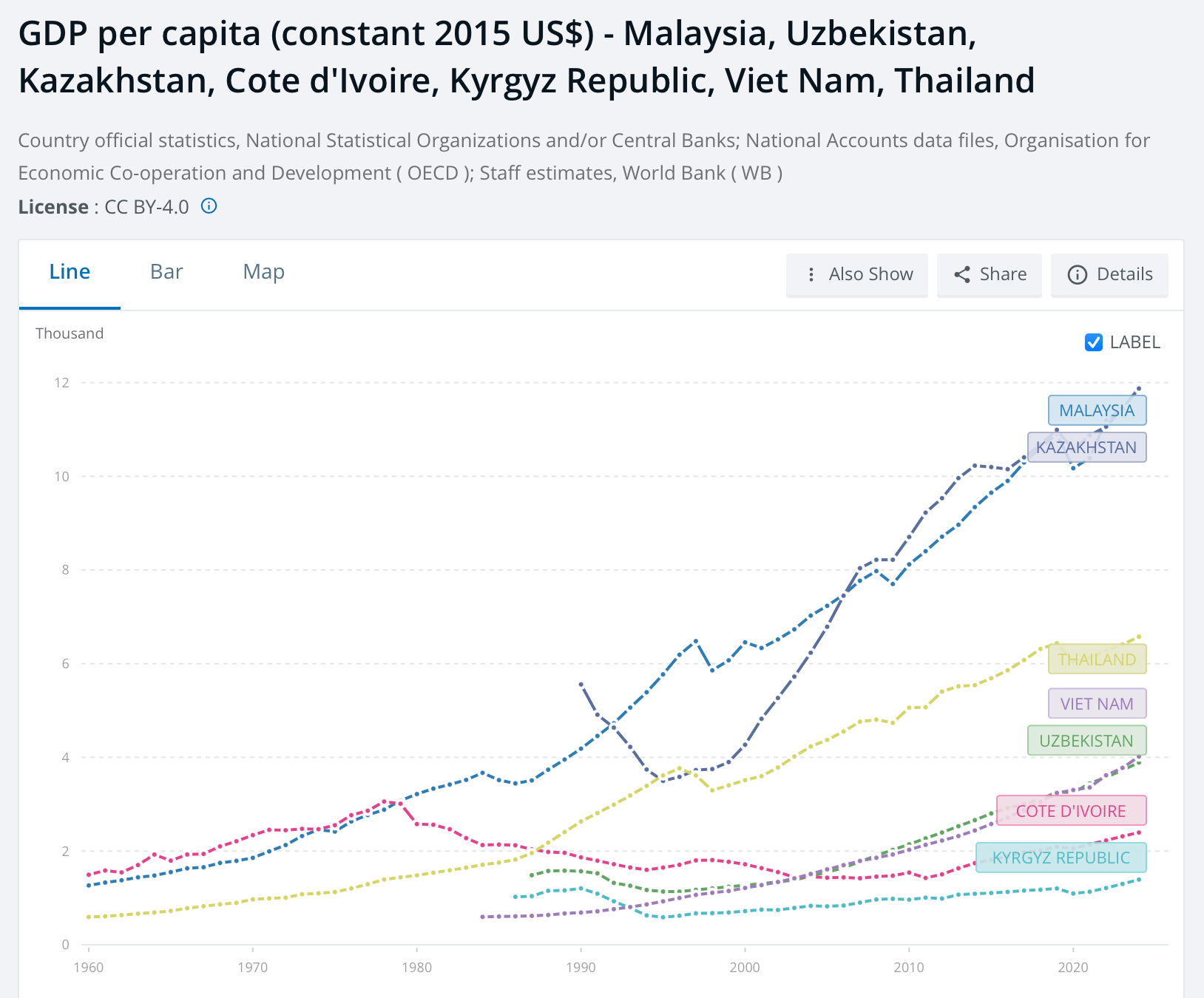
Compared to the other countries I’ve written about, Malaysia is a step up in prosperity - on level with Kazakhstan - but growing faster than Thailand (in yellow below), and almost as fast as Vietnam/Uzbekistan.
Malaysia has a quite high degree of economic freedom - 45th in the world with a score of 68 according to the Heritage Foundation, not far behind Poland at 68.5 or the UK at 70.4. This means business freedom is high; starting a company and getting licenses is significantly faster and less bureaucratic than in many emerging/frontier market peers. Property rights are quite strong and the risk of expropriation is low. It’s an export oriented country with low tariffs and a pro free trade stance.
It has a semiconductor industry and is having a datacenter boom (Chinese firms can go to Malaysia and get Nvidia chips). So it is much more plugged in to the world economy compared to say Uzbekistan, Nigeria or the Ivory Coast - which is good for Malaysia, but I like to have a portfolio that runs on its own beat and isn’t much impacted by global ups and down.
Malaysia is a significant oil producer (but far from being a petro-state) though, which has helped to insulate it from the current global energy crisis.
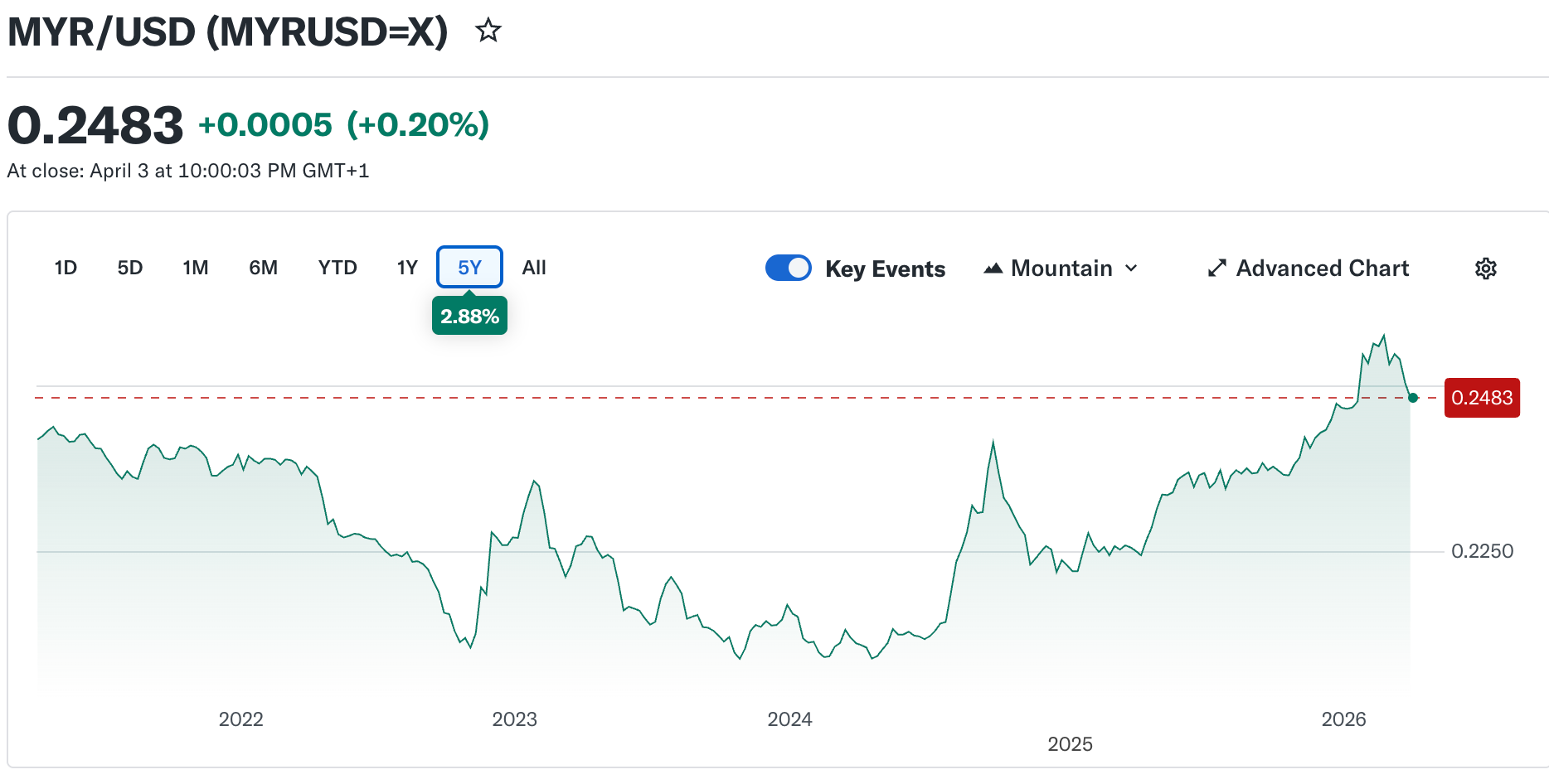
As to the currency (Malaysian Ringgit, MYR), it is fully convertible, and has held steady against the USD for 5 years now. Latest inflation figure was at 1.4% which is impressively low, and public finances are under control, with recently removed subsidies. Debt to GDP is 65%. Basically, these are first world figures, much closer to Switzerland than Kazakhstan, good job Malaysia!
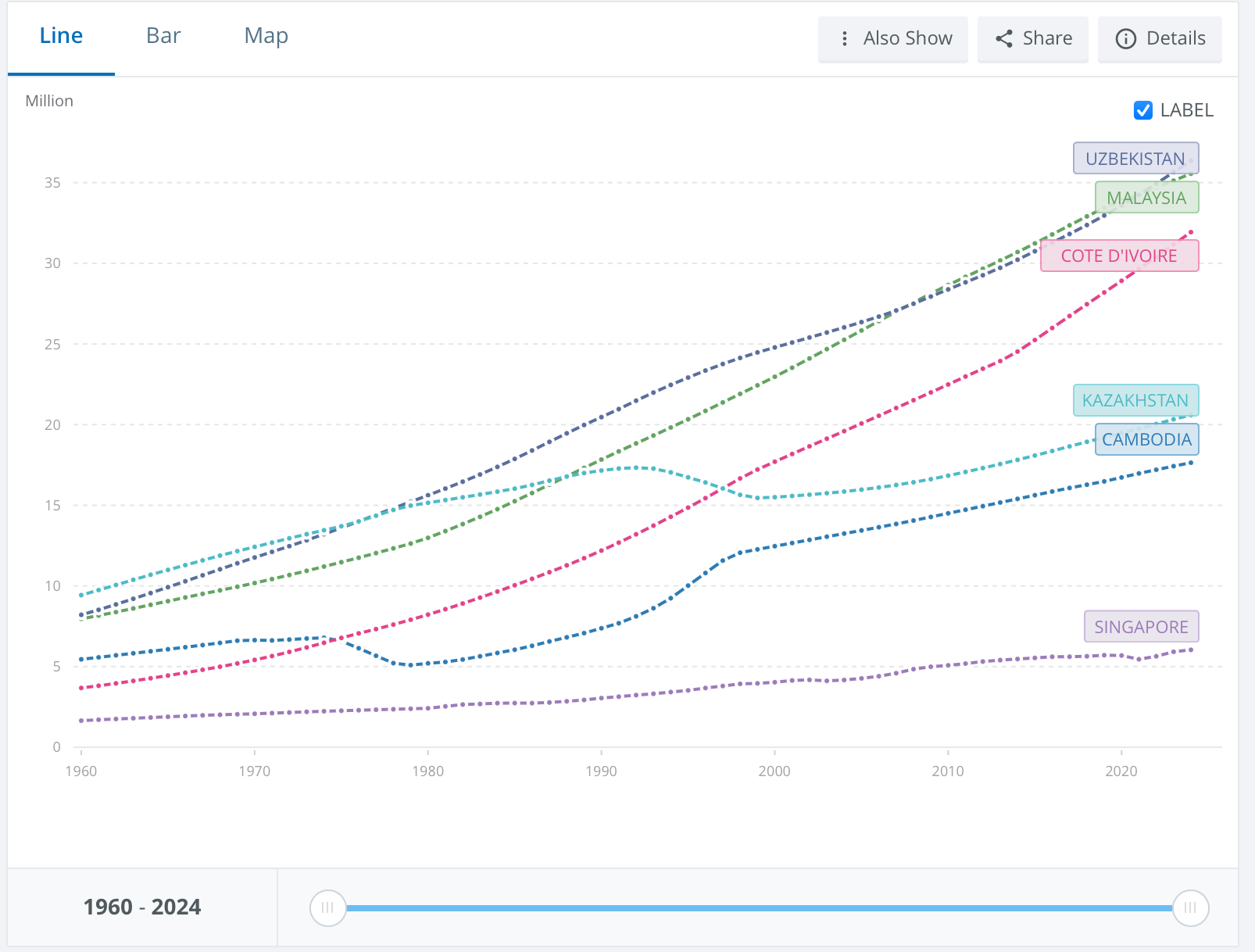
Population-wise Malaysia has 35 million people, and the population is growing, despite a fertility rate of only 1.6 children per woman. That’s because Malaysia had much higher birth rates 20–30 years ago (when it was a proper frontier market), so there is currently a very large cohort of people in childbearing age. Eventually the native population will stop growing, but that point is still far away, and Malaysia has net immigration so the total population might increase while the native population stagnates (like in neighboring Singapore).
Chinese Immigration
As to immigration, American sociologist Garett Jones argues in his book “The Culture Transplant”, that migrants bring with them not just labour, but also values, culture and “institutional memory” that impacts the places they migrate to. Jones says that if a poor or struggling country (he often uses Egypt or Paraguay as examples) wanted to jump-start its economy and improve its institutions overnight, the most effective policy would be to attract a massive wave of immigrants from China, as China has the last large pool of relatively poor people that have high institutional capital, high savings rates, high trust, pro-business culture.
And well, that’s exactly what Malaysia did - or more precisely what the British colonial government of Malaya did from 1870 to 1930, as they needed massive amounts of labor for the booming tin mining and rubber industries.
In any case, today 22.4% of Malaysian citizens are ethnically chinese.
The impact of the Chinese in Malaysia is quite obvious. Despite decades of affirmative action policies that favor the Malay majority, the Chinese community provides a disproportionate share of Malaysia’s Personal and Corporate Income Tax. Ethnic Chinese-led businesses comprise the vast majority of Malaysia’s Small and Medium Enterprises. Malaysia is currently the world’s 6th largest semiconductor exporter, and the Chinese community and Chinese-founded firms like Inari Amertron and Unisem (along with Western multinationals) are the primary driver of this.
Are Malaysian stocks cheap?
So, putting it all together; stable long term growth trend, population increase, economic freedom, and chinese community impact - it looks like Malaysia has a great path forward, and will just keep growing and become more prosperous.
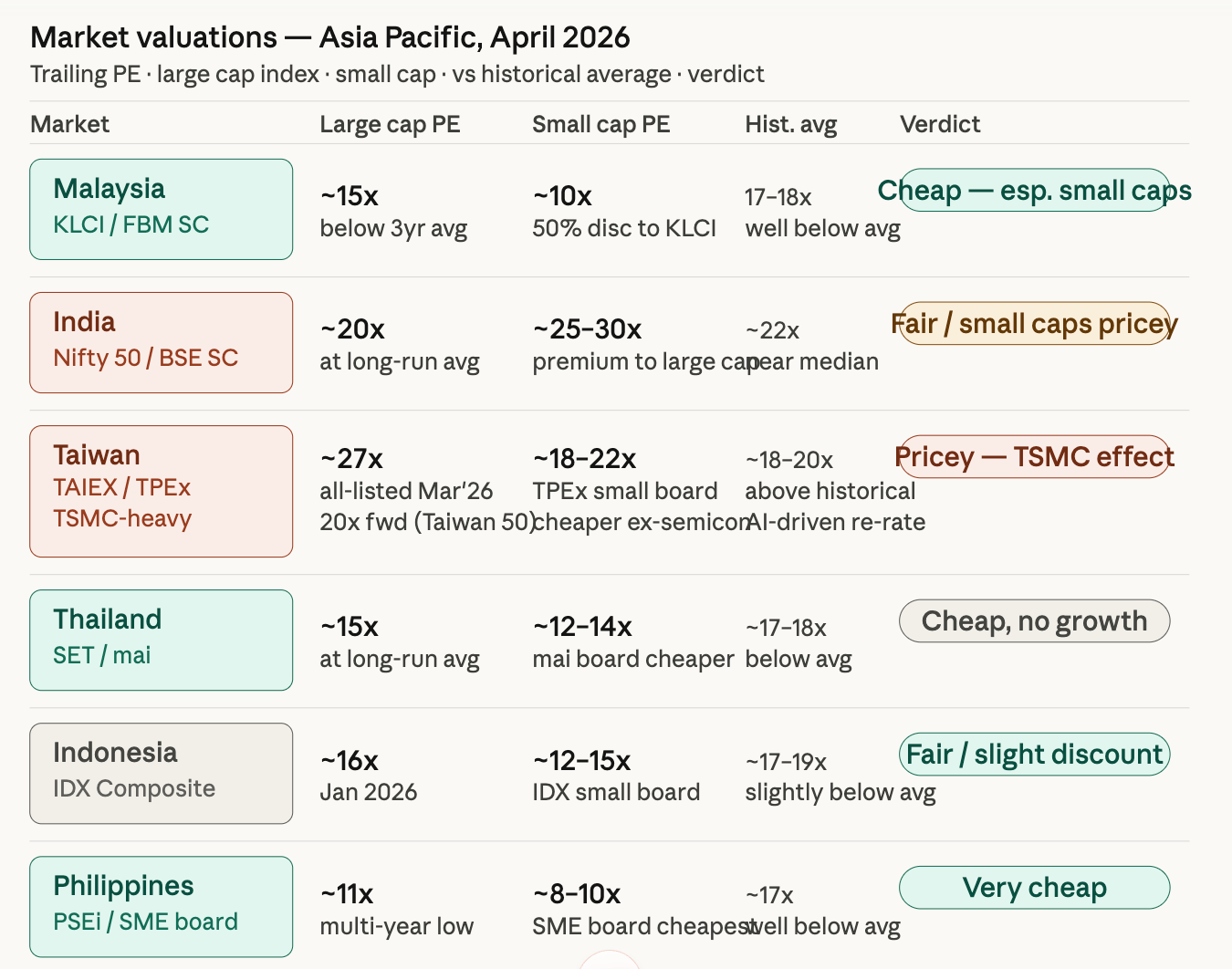
Is this reflected in the Malaysian Stock Market, which one would expect to be quite expensive? Not quite, Malaysian stocks are reasonably priced, especially small caps. Ok, you don’t get crazy stuff like in Africa with banks at P/E 2, or Uzbekistan/Kyrgyzstan where the most blue chip companies were at P/E 4, but compared to the rest of Asia Pacific, Malaysia looks good. And Malaysia has a large stock market with over 1,000 listed stocks, so it’s a good hunting ground.
Will look into Malaysian small caps in the next post.
Excited for this ! Great post. Something I can buy via ibkr.
Love the phrasing:
“ decades of affirmative action policies that favor the Malay majority”
Very nice way to say, that Indian and Chinese nationals are second grade citizens and heavily discriminated.
Penang is (soon was) majority Chinese hence it is top place in Malaysia to be.